
The Birth of an Imperial City (1070)
The history of Marrakech begins in 1070, when the Almoravid dynasty established a new capital on the Haouz plain at the foot of the Atlas Mountains. Founded by Abu Bakr ibn Umar and developed by Yusuf ibn Tashfin, the city was conceived as both a military stronghold and a thriving crossroads of commerce. Its strategic location allowed it to control vital trans-Saharan trade routes that carried gold, salt, textiles, and knowledge between sub-Saharan Africa, North Africa, and Al-Andalus. From the outset, Marrakech was more than a political seat—it was a dynamic center of cultural exchange and economic power.
The Almoravids fortified the city with ramparts of red earth that later earned it the nickname “the Red City.” They built mosques, palaces, gardens, and irrigation systems that transformed the arid landscape into a flourishing urban center. Marrakech rapidly grew into the heart of an empire stretching across present-day Morocco and deep into Spain.

The Almohad Golden Age
In the mid-12th century, the Almohad dynasty conquered Marrakech and made it the capital of their expanding empire. Under Almohad rule, the city reached a peak of intellectual, architectural, and political influence. Scholars, jurists, and philosophers gathered here, contributing to a vibrant intellectual climate that connected North Africa and Al-Andalus.
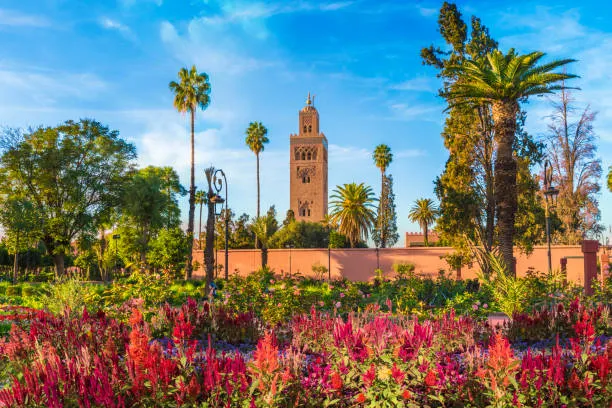
One of the most enduring symbols of this era is the magnificent Koutoubia Mosque. Completed in the 12th century, its elegant minaret stands nearly 70 meters high and became a prototype for later monuments, including the Giralda in Seville. The mosque reflects the Almohad commitment to architectural harmony, proportion, and spiritual grandeur.
Marrakech during this period was not only a seat of governance but also a center for artistic innovation. Urban planning, decorative arts, and religious architecture flourished, reinforcing the city’s reputation as one of the great capitals of the western Islamic world.

Saadian Revival and Architectural Splendor
After a period of relative decline, Marrakech experienced a renaissance in the 16th century under the Saadian dynasty. The Saadians restored the city’s status as an imperial capital and invested heavily in monumental construction projects that showcased their wealth and power.
Among their most celebrated legacies are the richly ornamented Saadian Tombs, rediscovered in 1917, where intricate stucco, marble, and zellij tilework demonstrate the height of Moroccan craftsmanship. Equally impressive is the grand El Badi Palace, commissioned by Sultan Ahmad al-Mansur after his victory at the Battle of the Three Kings in 1578. Though now partly in ruins, the palace once dazzled visitors with its vast courtyards, reflecting pools, and imported Italian marble.
During the Saadian era, Marrakech became a diplomatic and commercial hub, engaging in exchanges with Europe, the Ottoman Empire, and sub-Saharan Africa. The city’s prosperity was closely tied to trade networks that transported sugar, gold, and other valuable commodities.

Alaouite Continuity and Spiritual Significance
In the 17th century, the Alaouite dynasty rose to power. Although the political capital later shifted to other cities, Marrakech remained an essential royal residence and spiritual center. The Alaouites maintained and restored many monuments, ensuring the continuity of the city’s architectural and cultural heritage.
Throughout the centuries, Marrakech preserved its identity as a place where royal authority, religious devotion, and popular culture intersected. Its historic medina, enclosed by ancient walls, continued to thrive as artisans, traders, and scholars sustained traditions passed down through generations.
Jemaa el-Fnaa: The Living Heart of the City
No exploration of Marrakech’s history would be complete without mentioning Jemaa el-Fnaa. For centuries, this vast public square has served as the city’s social and commercial nucleus. By day, it bustles with merchants selling spices, fruits, and handcrafted goods. By night, it transforms into a stage for storytellers, musicians, acrobats, and food vendors.
Recognized by UNESCO as part of the Intangible Cultural Heritage of Humanity, Jemaa el-Fnaa embodies the living traditions that connect Marrakech’s past to its present. It reflects the city’s enduring role as a crossroads of cultures, where oral storytelling, performance, and trade continue to flourish.

Marrakech and the Trans-Saharan Trade
Marrakech’s rise to prominence cannot be separated from its strategic position along major trade routes. Caravans arriving from Timbuktu and other sub-Saharan centers carried gold, ivory, and manuscripts, enriching the city economically and intellectually. In return, Moroccan goods, religious scholarship, and artistic influences spread across regions.
These exchanges shaped Marrakech into a cosmopolitan metropolis long before the modern era. Its markets, caravanserais, and gardens symbolized both prosperity and openness to diverse influences. Architecture blended Berber, Arab, Andalusian, and African elements, producing a distinctive Moroccan style that remains visible today.
Colonial Period and Modern Transformation
In the early 20th century, Morocco came under French protectorate rule (1912–1956). During this period, Marrakech underwent urban expansion beyond its historic walls, with the development of the modern district known as Gueliz. While colonial policies altered aspects of governance and infrastructure, they also introduced conservation efforts that helped preserve the medina’s architectural treasures.
Following Morocco’s independence in 1956, Marrakech emerged as a leading cultural and tourism destination. Its palaces were restored, riads transformed into guesthouses, and traditional crafts revitalized. The city successfully balanced modernization with preservation, ensuring that its historic character remained intact.
A Lasting Legacy
Today, Marrakech stands as one of Morocco’s four imperial cities and one of the most visited destinations in Africa. Its red ramparts, palm groves, and snow-capped Atlas backdrop create a dramatic setting for a city shaped by nearly a millennium of history. From the Almoravid foundation to Almohad grandeur, Saadian splendor, and Alaouite continuity, each dynasty has left an indelible mark.
More than a collection of monuments, Marrakech is a living archive of Moroccan identity—where architecture, commerce, spirituality, and storytelling converge. Its enduring vitality testifies to its historical importance and ensures that the Red City remains a symbol of Morocco’s rich imperial heritage for generations to come.