
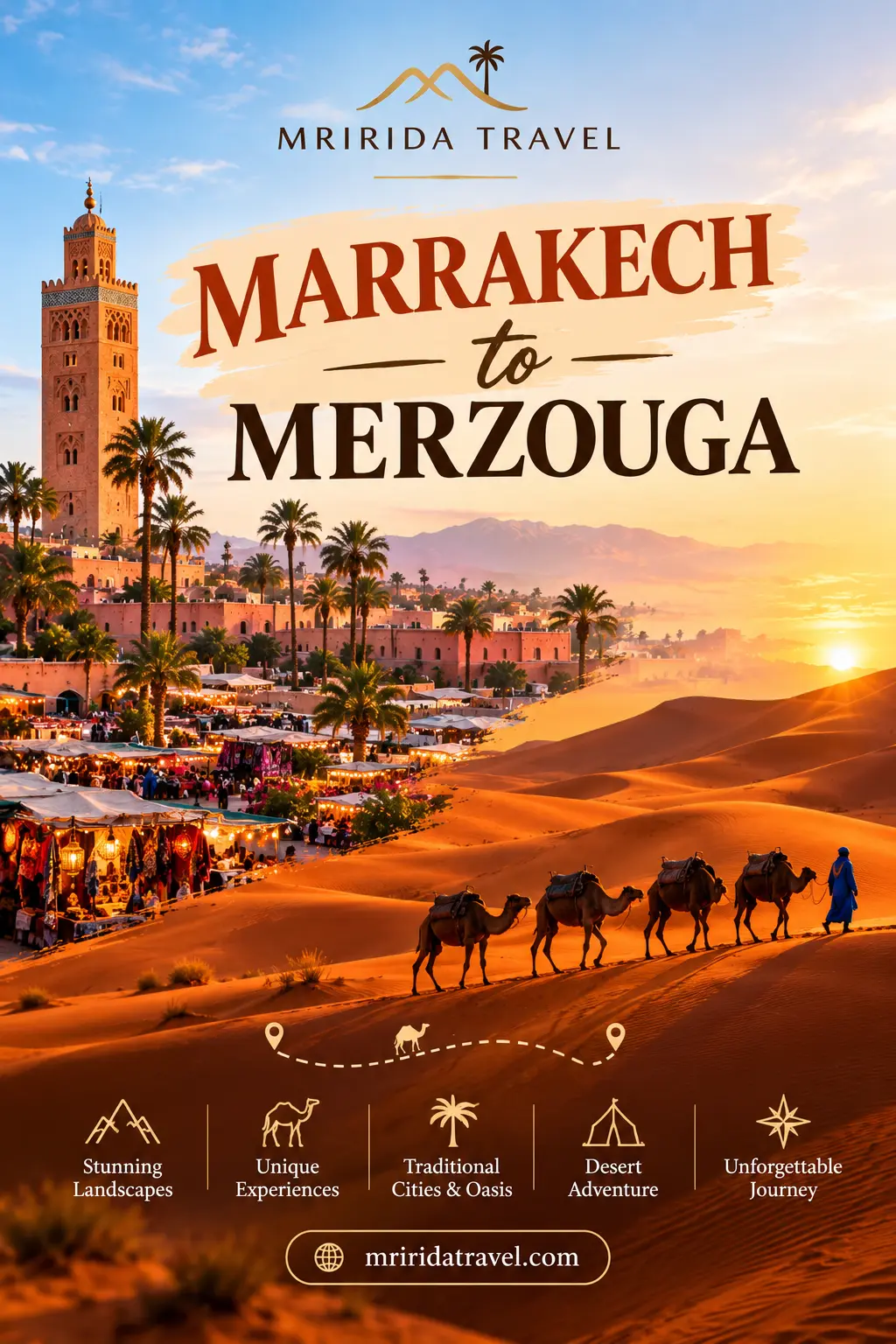
A Marrakech to Merzouga journey is much more than a drive from one Moroccan destination to another. It is an extraordinary road trip across some of the country's most dramatic landscapes, from the red walls and lively souks of Marrakech to the snow-capped peaks of the High Atlas, ancient kasbahs, spectacular valleys and, finally, the golden dunes of the Sahara Desert.
Along the way, travelers can discover the UNESCO-listed Aït Ben Haddou, explore Ouarzazate, travel through the Dades Valley, walk beneath the towering cliffs of Todra Gorge, pass through Erfoud and arrive at Merzouga, one of the gateways to the magnificent Erg Chebbi dunes. The Moroccan National Tourist Office specifically identifies Merzouga and Erg Chebbi as a major desert destination characterized by dunes, palm groves, tracks and hiking opportunities.
For travelers searching for a genuine Marrakech to Sahara Desert experience, this route combines adventure, culture, nature and authentic Moroccan hospitality in one unforgettable itinerary.


1. Start Your Journey in Marrakech
Your Marrakech to Merzouga tour begins in the Red City, one of Morocco's most fascinating destinations.
Before heading toward the Sahara, it is worth spending at least one day exploring Marrakech. Wander through the historic medina, visit the Bahia Palace, discover the Saadian Tombs and explore the traditional souks. In the evening, experience the atmosphere of Jemaa el-Fna, where food stalls, musicians, storytellers and local traditions create one of the city's most memorable experiences.
Marrakech is also an excellent starting point for a desert road trip because the city provides easy access to the High Atlas and the southern regions of Morocco. The Moroccan National Tourist Office describes Marrakech as one of the gateways toward Morocco's desert regions.
For travelers who want to extend their stay, MRIRIDA Travel also offers customizable Marrakech experiences combining the medina, cultural landmarks, the Atlas Mountains, traditional villages and private transportation.
2. Crossing the High Atlas Mountains
Leaving Marrakech behind, the landscape changes dramatically.
The road climbs toward the High Atlas Mountains, Morocco's spectacular mountain range. The High Atlas stretches for approximately 750 km and separates Atlantic Morocco from the country's Mediterranean and Saharan regions. It is also home to Mount Toubkal, the highest summit in North Africa at 4,167 metres.
One of the highlights of the road trip is crossing the Tizi n'Tichka Pass, traditionally associated with the route between Marrakech and southern Morocco.
As the road climbs, the scenery transforms from the ochre architecture of Marrakech into rugged mountain landscapes, Amazigh villages and panoramic valleys.
Travel tip
Do not rush this section of the journey. Stop at viewpoints when conditions allow, take photographs and enjoy the changing landscape. The journey itself is an important part of the experience.
3. Discover Aït Ben Haddou
One of the most impressive stops between Marrakech and Merzouga is Aït Ben Haddou.
This ancient fortified settlement, or ksar, is located on the southern slopes of the High Atlas in the province of Ouarzazate. UNESCO describes it as an outstanding example of southern Moroccan architecture and pre-Saharan earthen construction. Aït Ben Haddou was inscribed on the UNESCO World Heritage List in 1987.
Walking through its narrow passages and climbing toward the upper part of the ksar offers spectacular views over the surrounding landscape.
The site also has strong connections with Morocco's cinematic heritage and has become one of the most recognizable cultural landmarks on the Marrakech to Merzouga route.


Why visit Aït Ben Haddou?
- UNESCO World Heritage Site
- Traditional earthen architecture
- Historic caravan-route heritage
- Spectacular panoramic views
- Excellent photography opportunities
- Important cultural stop between Marrakech and Ouarzazate
4. Ouarzazate: The Gateway to Southern Morocco
Continue toward Ouarzazate, often associated with Morocco's film industry and known for its dramatic landscapes and kasbah architecture.
Ouarzazate provides a natural transition between the High Atlas and the desert regions farther east. The surrounding area includes historic villages, kasbahs, palm groves and mountain landscapes.
Depending on your itinerary, you can visit the film studios, explore the town or simply use Ouarzazate as a stop before continuing toward the Dades Valley.
The official Moroccan tourism itinerary also places Ouarzazate, Aït Ben Haddou, Skoura, Erfoud and Merzouga within a broader southern Morocco desert route.


5. Through the Dades Valley
From Ouarzazate, the road continues toward the Dades Valley, an area known for its contrasting landscapes of rocky mountains, green agricultural areas, palm trees and traditional villages.
The valley is particularly attractive for travelers who enjoy scenic road trips and photography.
Instead of treating the Dades Valley as simply an overnight stop, take time to appreciate the landscape. The contrast between the dry mountains and green oasis areas illustrates one of the defining characteristics of southern Morocco.


Where to stay
A traditional guesthouse, kasbah-style hotel or boutique accommodation in the Dades Valley can make the journey more comfortable and immersive.
A typical evening might include:
- Moroccan mint tea
- Traditional Moroccan dinner
- Local hospitality
- Mountain views
- Relaxing after a day on the road
6. Explore Todra Gorge
The next major attraction is Todra Gorge, near Tinghir.
The road takes you through the dramatic landscapes of the eastern High Atlas before reaching the impressive canyon. The towering rock walls create one of the most spectacular natural settings on the Marrakech–Merzouga route.
For travelers interested in nature and photography, Todra Gorge is an excellent place to stretch your legs and enjoy a short walk.
It also provides a welcome contrast to the vast open landscapes encountered later in the journey.


7. Erfoud: Entering the Desert Region
As you continue toward Merzouga, the landscape becomes increasingly arid.
The town of Erfoud is an important stop in this region and is well known for fossils and locally crafted stone products. It also marks an important transition toward the desert landscapes of southeastern Morocco.
From Erfoud, the road continues toward the Tafilalet region and eventually to Merzouga.
Historically, this region was connected with trans-Saharan caravan routes. The Moroccan National Tourist Office describes the Tafilalet as a transition zone where oasis landscapes gradually give way to the ochre tones of the desert.
8. Merzouga and the Magnificent Erg Chebbi
Then comes the moment many travelers have been waiting for: Merzouga.
Merzouga is a small desert settlement and one of the principal gateways to Erg Chebbi, a spectacular area of Saharan dunes.
The landscape changes almost completely. Mountains and valleys give way to waves of golden sand stretching toward the horizon.
The Moroccan National Tourist Office identifies Erg Chebbi as a destination of dunes, palm groves, desert tracks and hiking opportunities.
This is where your Marrakech desert trip becomes a genuine Sahara experience.


9. Experience Merzouga Camel Trekking
One of the signature experiences of a Marrakech to Merzouga itinerary is camel trekking across the Erg Chebbi dunes.
Typically, travelers meet their camel handlers near the dunes before beginning the ride toward the desert camp.
The experience is especially memorable around sunset, when the changing light creates dramatic colors across the sand.
A camel trek can offer an entirely different perspective of the Sahara. Instead of simply viewing the dunes from a vehicle, you experience the landscape slowly and quietly.
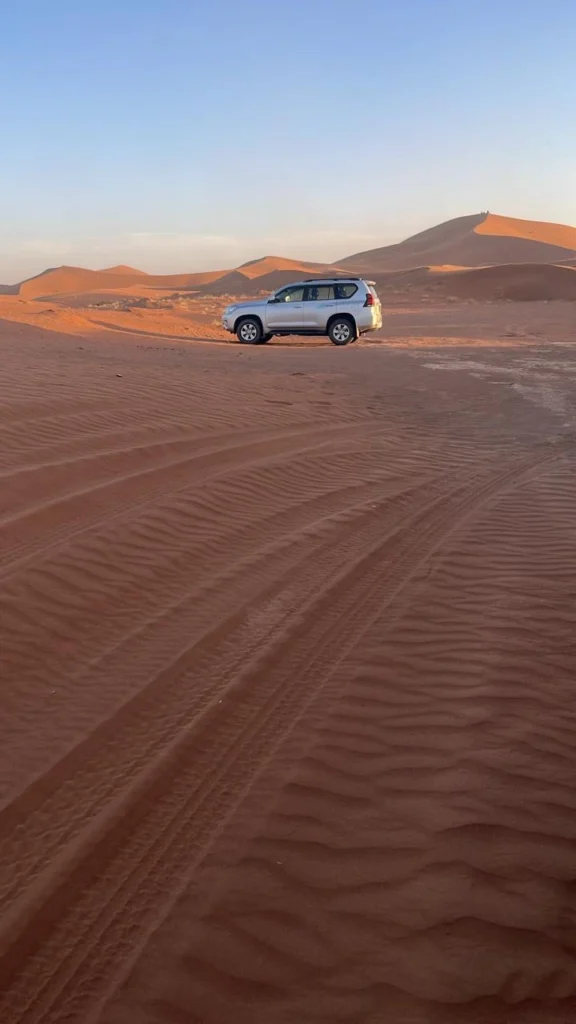
For travelers who prefer not to ride a camel, alternative transportation such as a 4x4 transfer can be arranged on some itineraries. MRIRIDA Travel's Marrakech–Merzouga tour, for example, offers a camel trek in Erg Chebbi while noting that a 4x4 transfer can be arranged as an alternative.
10. Spend the Night in a Sahara Desert Camp
After the camel trek, arrive at your Sahara desert camp.
This is often the highlight of the entire Morocco desert tour.
Depending on the camp category you select, you may stay in comfortable private tents with beds, electricity and private facilities while still enjoying the atmosphere of a traditional desert bivouac.
A typical evening can include:
- Moroccan dinner
- Traditional music
- Campfire
- Stargazing
- Relaxing around the dunes
- Traditional tea
- Sunrise over the Sahara
The Moroccan National Tourist Office specifically promotes overnight desert camping around Merzouga as part of the Moroccan desert experience.
At night, the absence of city lights creates an exceptional opportunity to look at the stars.
11. Wake Up for a Sahara Sunrise
If you spend the night in Erg Chebbi, set your alarm early.
A Sahara sunrise is one of the most memorable moments of the journey. As the first light reaches the dunes, the color and texture of the sand change continuously.
After breakfast at the camp, you can return to Merzouga by camel or 4x4 depending on your itinerary.
For photographers and content creators, early morning is also one of the best times to capture the dunes because the softer light creates strong shadows and textures.
12. Best Time for a Marrakech to Merzouga Trip
The best time for a Marrakech to Sahara Desert road trip depends on your tolerance for temperature and the activities you want to enjoy.
Spring: March to May
Spring generally offers pleasant conditions for sightseeing, road travel and outdoor activities.
It is a particularly attractive period for combining Marrakech, the Atlas Mountains and the desert.
Autumn: September to November
Autumn is another popular period for exploring Morocco's interior.
Temperatures become more comfortable after the hottest part of summer, making road trips and desert activities more enjoyable.
Summer: June to August
Summer can be very hot in the desert, particularly during the daytime.
If traveling during this period, plan outdoor activities around the cooler morning and evening hours and make sure you have sufficient water and sun protection.
Winter: December to February
Winter can offer clear skies and pleasant daytime temperatures in the desert, but nights can become surprisingly cold.
Important: desert temperatures can vary considerably between daytime and nighttime, so packing layers is essential.
13. What to Pack for Marrakech to Merzouga
A well-planned packing list can make your Marrakech Merzouga tour much more comfortable.
Essential items
- Lightweight breathable clothing
- Warm layer for desert evenings
- Comfortable walking shoes
- Sunglasses
- Sunscreen
- Hat or scarf
- Reusable water bottle
- Small backpack
- Camera or smartphone
- Power bank
- Personal medication
- Lip balm and moisturizer
For the desert camp
Bring something warm for the evening, even if you travel during a warm season.
For camel trekking, comfortable trousers and closed footwear are generally more practical than short clothing.
Luggage tip
For a desert excursion, keep your essentials in a smaller overnight bag if your tour operator transports larger luggage separately.
MRIRIDA Travel's published Marrakech–Merzouga itinerary specifically notes that large luggage can be transported separately by vehicle during the camel trek.
14. Suggested Marrakech to Merzouga Itinerary
If you have enough time, we recommend allowing at least 4–5 days for the journey rather than attempting to reach the Sahara as quickly as possible.
A sample itinerary could look like this:
Day 1 — Marrakech
Explore Marrakech.
Overnight: Marrakech
Day 2 — Marrakech → High Atlas → Aït Ben Haddou → Ouarzazate → Dades Valley
Cross the High Atlas via Tizi n'Tichka, visit Aït Ben Haddou and continue toward Ouarzazate and the Dades Valley.
Overnight: Dades Valley
Day 3 — Dades → Todra Gorge → Erfoud → Merzouga
Explore Todra Gorge, continue through Erfoud and arrive in Merzouga.
Enjoy Merzouga camel trekking at sunset.
Overnight: Sahara desert camp
Day 4 — Merzouga → Draa Valley → Ouarzazate → Marrakech
Wake up for sunrise, have breakfast and begin the return journey.
Overnight: Marrakech
Day 5 — Departure
Transfer to Marrakech airport or continue your Moroccan adventure.
This structure is broadly consistent with the route offered in MRIRIDA Travel's current 5-day Marrakech–Merzouga desert itinerary, which includes the High Atlas, Aït Ben Haddou, Ouarzazate, Dades Valley, Todra Gorge, Erfoud, Erg Chebbi and a desert camp.
15. Why Choose a Private Marrakech Merzouga Tour?
A private Marrakech Merzouga tour provides more flexibility than simply following a fixed transportation schedule.
You can often adjust:
- Departure times
- Photography stops
- Meal breaks
- Accommodation category
- Activities
- Length of stays
- Desert camp category
- Camel trekking arrangements
- Additional cultural visits
This flexibility is particularly valuable on a long road trip because the landscape itself is part of the experience.
For families, couples and small groups, private transportation also allows travelers to enjoy the journey at their own pace.
MRIRIDA Travel offers private and customizable Moroccan experiences with private transportation, bilingual guides and personalized itineraries.
16. Marrakech to Merzouga: More Than a Desert Trip
One of the biggest advantages of this route is its diversity.
You do not simply travel from a city to the Sahara.
You travel through several distinct Moroccan environments:
Marrakech → High Atlas → Aït Ben Haddou → Ouarzazate → Dades Valley → Todra Gorge → Erfoud → Merzouga → Erg Chebbi
The journey combines:
🏙️ City life — Marrakech
🏔️ Mountains — High Atlas
🏰 Heritage — Aït Ben Haddou
🎬 Cinema and kasbahs — Ouarzazate
🌴 Oases and valleys — Dades and Tafilalet
🪨 Canyons — Todra Gorge
🏜️ Desert — Erg Chebbi
🐪 Adventure — Camel trekking
⛺ Hospitality — Sahara desert camp
🌅 Nature — Sunrise and sunset over the dunes
That variety is what makes a Marrakech to Merzouga road trip one of the most rewarding ways to experience southern Morocco.
17. Frequently Asked Questions
How long does it take to travel from Marrakech to Merzouga?
The route is best experienced over several days because the journey includes major attractions such as the High Atlas, Aït Ben Haddou, Ouarzazate, Dades Valley and Todra Gorge before reaching Merzouga.
Rather than treating it as a single long transfer, a 4–5 day itinerary allows time to explore the destinations along the way.
Is Marrakech to Merzouga worth it?
For travelers interested in combining mountains, Moroccan heritage, valleys, desert landscapes and cultural experiences, the route offers a highly varied Moroccan journey.
The biggest attraction is that the destination is not the only highlight—the road itself passes through several contrasting landscapes.
Can I visit the Sahara from Marrakech?
Yes. Marrakech is one of the main starting points for journeys toward Morocco's southern desert regions. The Moroccan National Tourist Office specifically presents Marrakech as a gateway toward the Sahara.
Is camel trekking in Merzouga suitable for beginners?
Camel trekking is offered as a tourist activity in Erg Chebbi, and MRIRIDA Travel's itinerary states that its camel trek is guided by local professionals and can be replaced by a 4x4 transfer if preferred.
Where do you sleep during a Sahara desert tour?
Many itineraries include an overnight stay at a desert camp near Erg Chebbi. Depending on the package, travelers may choose between standard and more comfortable luxury-style tents.
What should I wear for a desert trip?
Choose comfortable, breathable clothing during the day and bring warm layers for the evening. Comfortable walking shoes, sunglasses, sunscreen and a hat are also recommended.
Can the Marrakech to Merzouga itinerary be customized?
Yes. A private itinerary can be adapted according to travel dates, accommodation preferences, interests and available time. MRIRIDA Travel describes its private Morocco experiences as customizable, with options for transportation, accommodation and activities.
Book Your Marrakech to Merzouga Sahara Adventure with MRIRIDA Travel
The road from Marrakech to Merzouga is a journey through the many faces of Morocco.
From the vibrant streets of Marrakech to the dramatic High Atlas Mountains, from the ancient walls of Aït Ben Haddou to the canyons of Todra Gorge, every stage brings a new landscape and a new experience.
Then, as the road approaches Merzouga, the scenery changes once again. Mountains and valleys give way to golden dunes, camel tracks and the vast silence of Erg Chebbi.
With MRIRIDA Travel, you can turn this route into a carefully organized private Morocco desert tour, including comfortable transportation, selected accommodations, local experiences, camel trekking and a night in the Sahara.
Ready to experience the Sahara?
Explore the MRIRIDA Travel Marrakech to Merzouga Desert Tour
Discover more Morocco experiences: MRIRIDA Travel Tours
Start planning your Moroccan adventure today — from Marrakech to the golden dunes of Merzouga.